AI-Powered Workflows for Small Engineering Teams
Small engineering teams are often expected to deliver the same level of software quality, documentation and technical support as much larger organisations. The challenge is rarely a shortage of engineering knowledge; it is the amount of time engineers spend on repetitive work around the engineering itself. Investigating logs, searching documentation, reviewing code, writing test reports, updating issue trackers and answering recurring technical questions can consume a significant part of the working week.
AI-powered workflows offer a practical way of reducing this overhead. The goal is not to replace engineers or hand engineering decisions to an AI system. Instead, AI can act as an additional layer around existing tools and processes: gathering information, performing first-pass analysis, producing summaries and automating predictable parts of a workflow.
From AI assistant to AI workflow
Many teams initially use generative AI as a sophisticated chat interface. An engineer asks a question, provides some code or data and receives an explanation. This can be useful, but it still requires the engineer to collect the information and initiate every interaction.
An AI-powered workflow goes a step further by connecting the AI to the systems involved in the engineering process.
- Retrieve the failed test result and associated logs.
- Identify the hardware configuration and software version used for the test.
- Search previous failures and engineering documentation for similar symptoms.
- Ask an AI model to analyse the collected information.
- Produce a concise failure summary with likely causes.
- Create a draft issue for an engineer to review.
The engineer remains responsible for the technical decision, but much of the information gathering and administrative work has already been completed. AI becomes significantly more useful when it is integrated into a workflow rather than treated simply as another application engineers must use.
Where AI can help
Test and failure analysis. Automated test systems already generate large quantities of results, logs and diagnostic information. AI can provide a first-pass analysis, identify unusual measurements, extract relevant errors and compare a failure with previous results.
Software development. AI can assist with code reviews, explain unfamiliar code, generate unit-test cases, identify possible edge cases and produce initial documentation for APIs or classes. These activities can be integrated into the existing development workflow rather than requiring developers to manually submit code to a separate system.
Documentation and knowledge retrieval. Small teams frequently have important technical information distributed across specifications, design documents, source repositories, calibration procedures and historical test reports. An AI system using retrieval can search approved sources and present relevant information in the context of an engineer's question.
Engineering administration. Release notes can be generated from completed work items, test results can be converted into reports, meeting notes can become actions and lengthy technical discussions can be summarised for other members of the team.
Agents make workflows more powerful
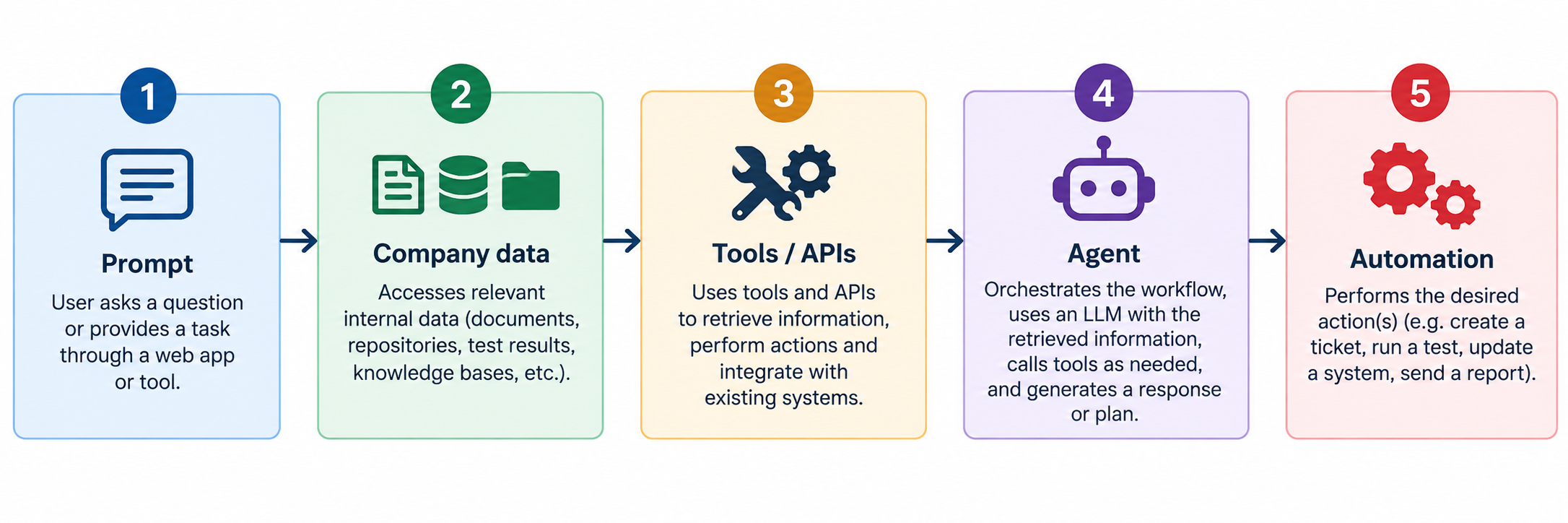
Some workflows can be implemented with a simple model request: provide information and ask the model to summarise or classify it. More complex workflows can benefit from an AI agent. An agent combines an AI model with instructions and access to tools. Instead of only generating text, the agent can decide that it needs additional information and call an appropriate tool or API.
Example: "Why did device 1047 fail the RF calibration overnight?"
A useful engineering agent might retrieve the test record, inspect the relevant log entries, query the calibration database, identify the software and hardware versions and compare the result with previous successful runs. The AI model can then reason over that collected information and present the engineer with a concise explanation. This is more useful than asking a general-purpose model the same question because the answer is grounded in information from the team's actual engineering systems.
Platforms such as Microsoft Foundry are designed to support this type of agentic workflow, including model access, tool integration, tracing and evaluation.
Keep humans at the important decision points
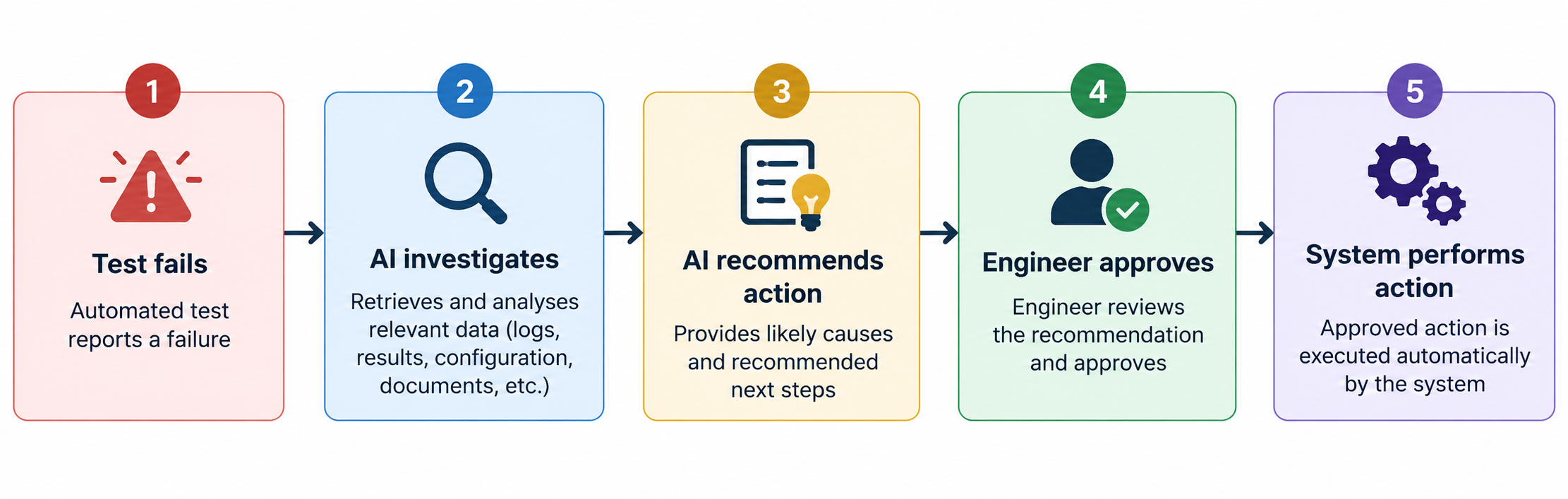
Automation does not mean that every step should be autonomous. A useful design principle is to separate information processing from engineering authority. AI is particularly effective at searching, summarising, categorising and generating suggestions. Decisions that could affect hardware, production data, releases or customers should normally retain an explicit approval step.
Start small
One of the biggest mistakes a small team can make is attempting to build a general-purpose engineering AI platform before demonstrating a useful application. A better starting point is to identify a repetitive task that engineers already understand well.
A good candidate usually has three characteristics: it happens frequently, the required information is already available digitally, and an engineer can easily determine whether the AI's output is correct. A test-failure summariser, log analyser or documentation assistant is therefore often a better first project than a completely autonomous engineering agent.
Treat AI workflows as engineering systems
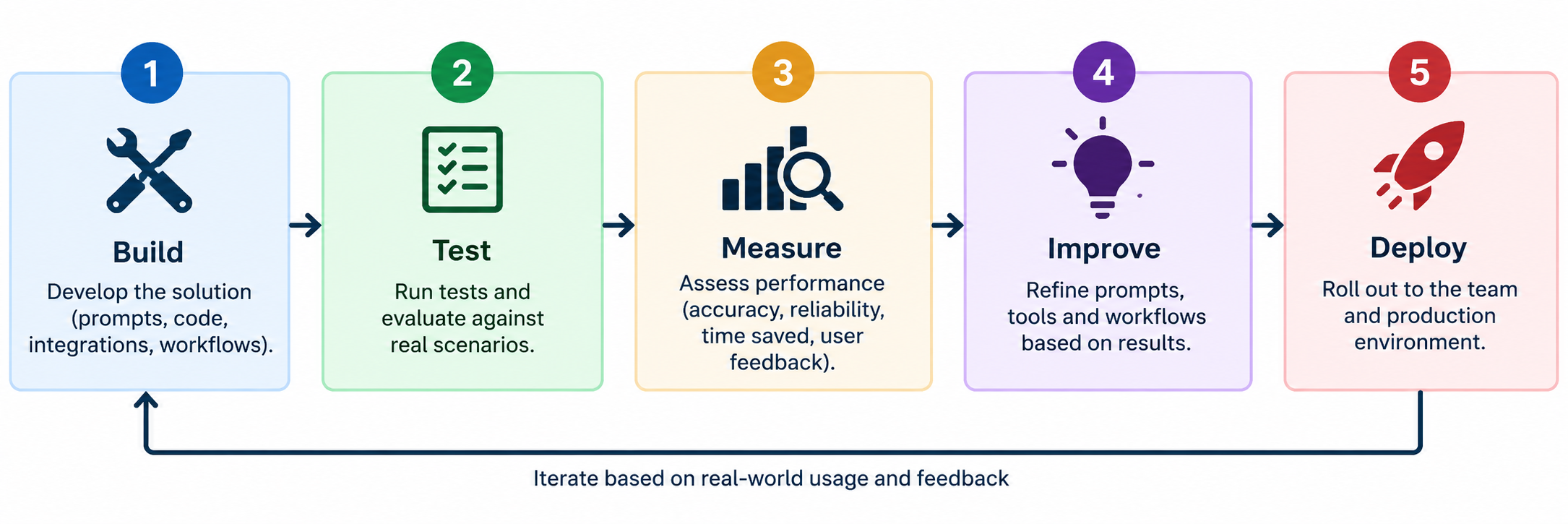
AI applications still require conventional software-engineering discipline. Authentication, permissions, logging, version control, error handling and monitoring remain important. There is also an additional requirement: evaluation.
Because AI output is probabilistic, a conventional unit test such as expected == actual is not always sufficient. Teams should maintain representative test cases and evaluate whether changes to prompts, models, tools or knowledge sources improve or degrade the system. This turns AI development into a familiar engineering cycle:
The advantage for small teams
The biggest opportunity for a small engineering team is not necessarily doing something that was previously impossible. It is removing dozens of small pieces of friction from everyday engineering work. An engineer might save five minutes locating a specification, ten minutes investigating a familiar test failure, fifteen minutes preparing a report and another ten minutes documenting a code change. Individually, none of these tasks justifies a major software project. Collectively, they represent a substantial amount of engineering time.
AI-powered workflows allow a small team to capture some of that time while retaining the judgement and domain expertise of its engineers. The most successful implementations are therefore likely to be the least dramatic: AI quietly integrated into the tools engineers already use, collecting information, performing routine analysis and preparing the next step.
The objective is not to create an AI engineer. It is to give every engineer better leverage over their time.