When Should a Small Business Invest in AI?
A practical guide to deciding when artificial intelligence will create real business value - and when to wait.
Start with the business problem, not the technology
AI investment works best when it is tied to a clear operational problem or opportunity. A company that begins with “we need an AI strategy” can easily spend money on tools that employees rarely use. A better starting point is to identify work that is repetitive, slow, expensive, difficult to scale, or dependent on searching and processing large amounts of information.
Good early candidates often include drafting routine documents, summarising meetings, responding to common customer questions, classifying enquiries, analysing spreadsheets, extracting information from documents, preparing marketing material, supporting software development, and helping staff search internal knowledge.
- Staff repeat the same information-heavy task.
- A bottleneck is limiting growth.
- Faster analysis would improve decisions.
- Existing data is reasonably organised.
- The result can be checked by a person.
- The process itself is poorly defined.
- Errors could create serious legal, safety or financial harm.
- Sensitive data cannot be handled appropriately.
- There is no owner for the new process.
- The expected benefit cannot be measured.
Look for measurable return
Small businesses rarely need to begin with a large custom AI project. The strongest first investments are often modest: a paid AI assistant, an AI feature already available in existing software, or a small automation connected to a well-understood workflow. The investment should be judged against a simple baseline: how much time or money does the task consume today, and what improvement would matter?
For example, if a five-person team each spends two hours a week preparing routine reports, the business is using roughly 40 staff-hours per month. If an AI-assisted workflow safely cuts that effort in half, the value can be compared directly with subscription, implementation and review costs. The calculation does not need to be perfect; it simply needs to prevent enthusiasm for the technology from replacing a business case.
The five readiness questions
Is there a clear use case? Choose a specific task rather than a broad ambition such as “use AI across the company.”Is the work frequent enough? Automating a task performed every day or every week usually creates more value than optimising an occasional activity.Can the output be checked? Early AI use is safer when an employee can quickly review the result before it affects a customer or business decision.Is the information suitable? Consider confidentiality, personal data, intellectual property and any contractual or regulatory restrictions before putting information into an AI service.Can success be measured? Define one or two measures such as hours saved, response time, conversion rate, error rate or customer satisfaction.
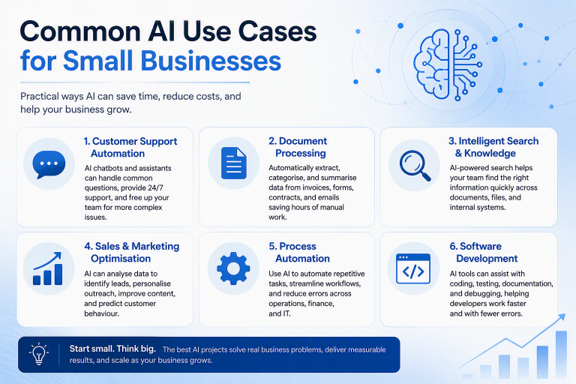
Common AI Use Cases for Small Businesses
Practical use cases include customer support assistants, document processing, internal knowledge search, report generation, software development assistance, and workflow automation. The most successful projects focus on solving a specific business challenge rather than implementing AI for its own sake.
Invest in stages rather than making one big bet
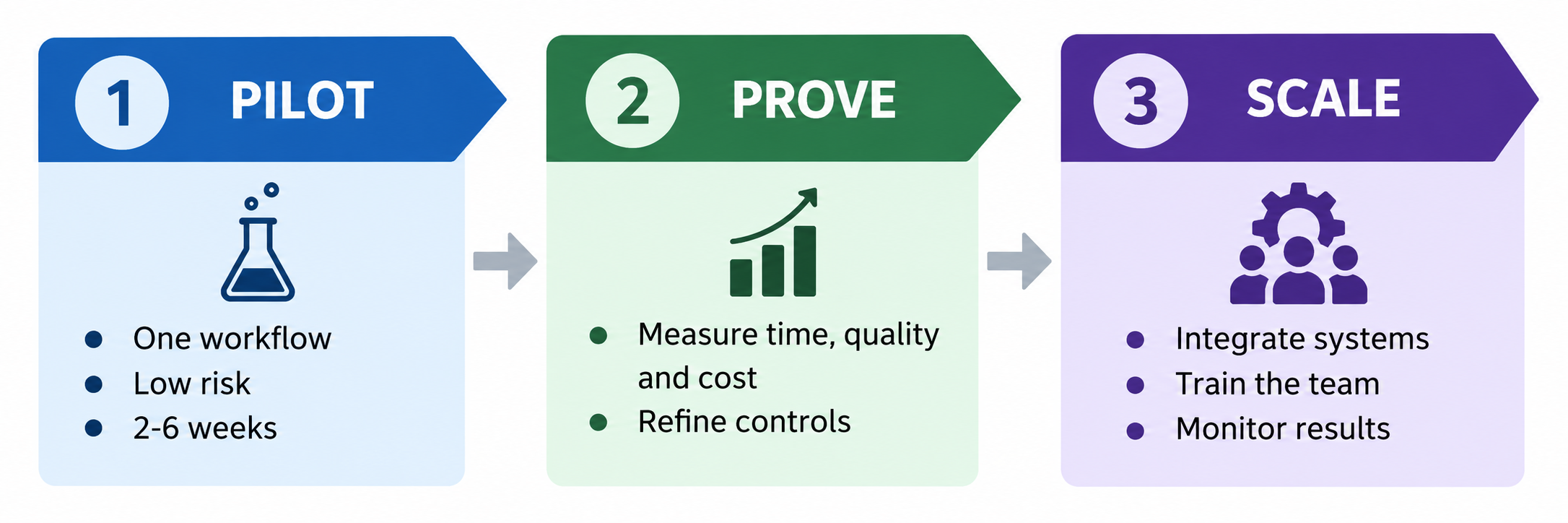
For most small businesses, AI adoption should be an experiment-and-expand process. Start with one contained use case, give it a clear owner, and run it for long enough to compare the new process with the old one. Keep human review in place while the team learns where the system performs well and where it fails. If the pilot produces a repeatable benefit, expand it or connect it more deeply to existing systems.
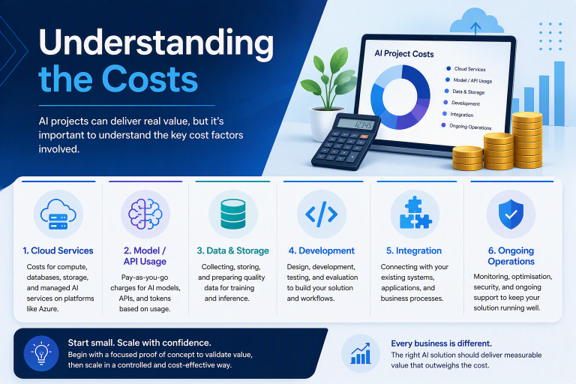
Understanding the Costs
The cost of an AI initiative can vary considerably depending on the complexity of the solution. Typical costs include platform subscriptions, cloud services, integration work, implementation effort, and ongoing support. Starting with a limited pilot project is often the most cost-effective approach.
When it may be better to wait
AI is not automatically the best solution. If a process is inconsistent, poorly documented or rarely performed, ordinary process improvement may deliver more value first. Likewise, if the business lacks usable digital data, fixing the underlying information flow may be more important than adding AI. Some problems are better solved with a simple software rule, template, database query or conventional automation.
A simple investment test
That approach keeps the focus on business value rather than hype. AI does not need to transform the whole company to be worthwhile. A handful of well-chosen applications that save employees time, improve responsiveness or make expertise easier to access can provide a meaningful return - and create the experience needed for more ambitious projects later.
Summary
Invest in AI when you can connect a defined problem to a measurable benefit. Start small, keep people in control, prove the value, and scale what works.
Further reading
- AI Adoption Research – GOV.UK
- Empowering SMEs in the Age of AI – OECD
- Employer Guide: What Works for AI Upskilling – GOV.UK
- SME Digital Adoption Taskforce: 2026 Update – GOV.UK